Social Media Mayhem or Effective Marketing?

Having recently helped promote a workshop on Facebook and LinkedIn, it was interesting to have some feedback on our main topic of marketing. Although not universally popular, it is necessary if you want potential and existing clients to know what you do and whether what you offer has changed.

[Photo by Merakist on Unsplash]

How can clients find you?

So, what is marketing? According to Oxford Dictionaries, marketing is “the activity or business of promoting and selling products or services, including market research and advertising”. CIM, the Chartered Institute of Marketing, defines marketing as “the management process responsible for identifying, anticipating and satisfying customer requirements profitably. This may sound somewhat cold and calculated, but, unless you are translating as a hobby, you presumably need a strategy to make this your career.

Do you know your market?

If you have professional experience or qualifications in a specific subject, besides languages, this could be your main source of work. Do you know the clients who would benefit from translation in this field? Where are they based? Could you work for them directly? If you don’t have any specialist experience, do you have any hobbies or interests that you could develop into a specialism? Do you work for agencies? If so, are you happy with the projects on offer and the rates paid? How can you change this, if you’re not happy?

Do you have a website? If not, how do you communicate to potential clients about what you do? Can they find you on a professional database, such as that of the ITI (Institute of Translation and Interpreting) (https://www.iti.org.uk/find-professional-translator-interpreter.html) or CIOL (Chartered Institute of Linguists) (https://www.ciol.org.uk/find-a-linguist)? Do you have a blog? Do you use social media? Do you network with colleagues? Do you attend trade shows and conferences?

[Photo by Mariia Shalabaieva on Unsplash]

So many questions, so little time

If this all seems overwhelming, take some time to reflect on whether you are happy in your work. If something could be better, do something to change that. There are so many opportunities to improve your situation. You may also find you enjoy particular projects and want to increase your work in that area. If so, tell your client how much you enjoy what they do and how you like being part of their team.

Meanwhile, if you want more expert advice, ITI’s Western Regional Group (https://www.itiwrg.org.uk/news.php) will be holding its Members’ Day on Saturday 15th November. Here, Sara Witham of Evil Empire Marketing (https://evilempire.co.uk/) will offer you some answers on how to market yourself. If you have any ideas and wish to share them, please drop me a line in the comments.


From Planting to Flourishing

For weeks, I have been watching spring bulbs in our garden growing green shoots. Each day, there would be more, but no flowers. Then, a week ago, the first flower appeared and more kept popping up and opening as if by magic.

[An allium in bud and a flowering allium]

Just yesterday, I attended a Zoom networking event. One of the topics discussed was how to find clients – relevant to any freelancer of course. You might have qualifications and be ready to work, but where is anyone who needs you? What on earth have these 2 scenes got in common?!

Well, after applying to translation agencies whilst studying on my MA, several polite replies came, some happy to ‘keep my name on file’, but no actual work offers arrived. I did some temping and evening classes in subjects related to my interests and potential work. One day, just over a year later, an agency that had ‘kept my name on file’ contacted me with a genuine project. After successfully completing it, I realised I was now a practising translator, not just a qualified one. This agency gave me more work. I could write about the work I was doing on my CV. Other agencies offered me work, then colleagues did so and referrals from colleagues even opened up opportunities to work with direct clients. These then recommended me to other direct clients. Somehow, the seed I had planted was starting to flower. Was I simply lucky? This is partly true. I am also extremely grateful for the advice I have received.

How to blossom as a translator:

1) Be (politely) persistent!

2) Join a professional organisation whilst studying. You can learn new skills in workshops and meet colleagues. Both the Chartered Institute of Linguists https://www.ciol.org.uk/ and the Institute of Translation and Interpreting https://www.iti.org.uk/, with its many subject, language, regional and support networks, offer solidarity and an opportunity to advertise your skills.

3) Learn from experienced translators at workshops and in forums – everything from subject and language skills to setting up your office and online presence.

4) Be flexible – not all work is translation or interpreting. Proofreading and editing are often required.

5) Be sociable – networking is not just about work, but should be fun. There are regular meet-ups with colleagues from pubs to walks and art exhibitions.

6) Write about what you do workwise and in your spare time – on your website, in professional journals and anywhere relevant to your specialisms. One of my hobbies has become a specialist subject in my translation work.

7) Be optimistic!

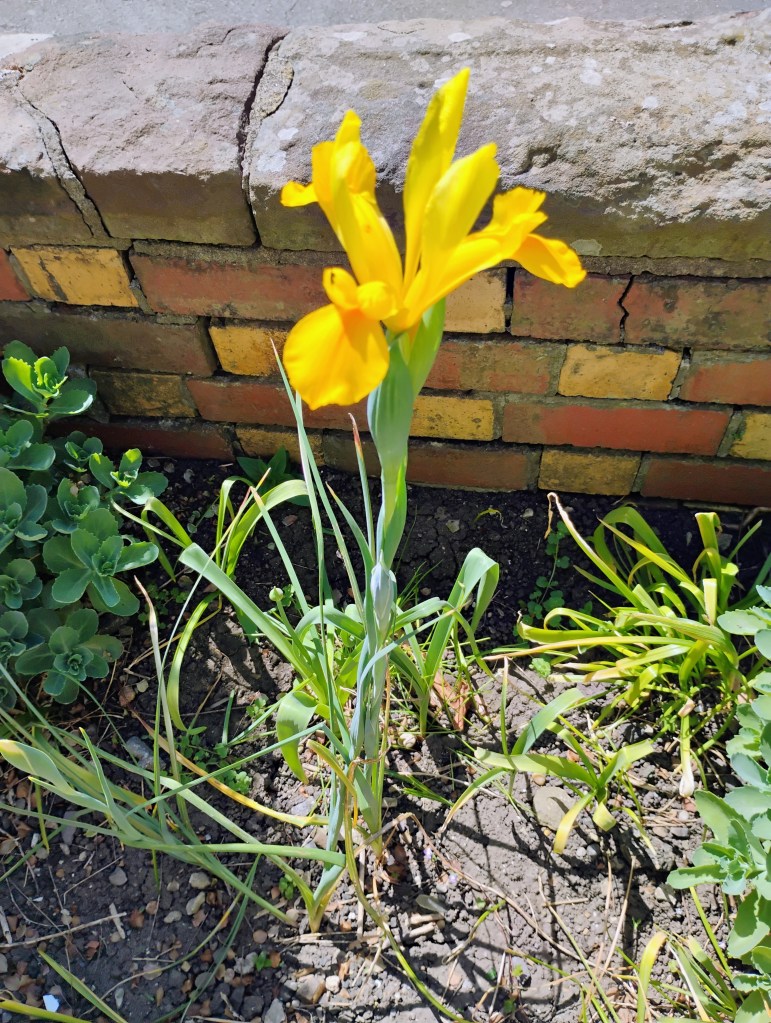
[A yellow iris]

Good luck!

Ode to Autumn Networking

John Keats described autumn as the “season of mists and mellow fruitfulness”. So, it feels like a time to wind down before the year ends. It is also, in contrast, the start of the new academic year and, therefore, a time to refresh our perspective. For me, there have been several networking events from a Business Boost Day to the Members’ Day for my regional network through to ‘Netwalking’ (walking and networking in the Forest of Dean) alongside online events in my subject and language networks.

[Fallen leaves near the Dean Heritage Centre, Gloucestershire]

Becoming fruitful

As freelance translators, it’s easy to keep working without reflecting on our business strategy. Momentary disappointments may seem huge without taking time to assess our successes. At a Business Boost Day in September, we were encouraged to assess what has changed in the past 18 months in terms of our workload, client base, specialisms and earnings. Then, we discussed how we can react and adapt to change. We also talked about our success stories with an action plan to focus on work from our favourite clients.

Being mindful

A session on mindfulness at our Members’ Day made a room full of linguists fall silent – more than once! Focusing on our breath, however, brought clarity of thought and new insights into how we could improve our working day to stop us feeling overwhelmed. Even walking can be mindful if you take each step slowly and keep your mind free by again focusing on your breathing.

Netwalking

Spending what turned out to be a splendid autumn day walking in the Forest of Dean, Gloucestershire, was a great escape from our desks. It was a chance to discuss work, network and walk – hence the term ‘netwalking’. Appreciating our surroundings, our colleagues and considering our work/life balance was uplifting. Our reward for a good 2 hours of walking was delicious refreshments in the Dean Heritage Centre Café.

[The Forest of Dean, Soudley, Gloucestershire]

The year ahead…

Bringing together these positive experiences gives me renewed energy. I look forward to working with focus and creativity for my clients and with my colleagues.

———————————————————————

With thanks to Becca George (ITI Western Regional Group) and Lloyd Bingham (ITI Cymru Wales Group) for the Business Boost Day, Claire Moreau of Bridgemaker Mindfulness for the mindfulness session as part of the ITI Western Regional Group’s Members’ Day and Astrid Freuler (ITI Western Regional Group) for the guided ‘Netwalking’. More details about the ITI (Institute of Translation and Interpreting) are available here:

https://www.iti.org.uk/

AI Chatter – Do Shortcuts Matter?

A job advert recently popped into my inbox. It was in English, but the job itself was based in Germany. A line in the email simply recommended using “intelligent programs” to understand the job description on the company’s website.

How odd, I thought. If you want to work abroad, it certainly helps if you can read and write the relevant language – from shopping to getting a doctor’s appointment through to enjoying hobbies and making friends. Having worked in Germany, this seems obvious to me. So, why would you expect someone to use a tool to understand their future working environment?

Save time and get the gist

What is an intelligent program? The OED defines AI (artificial intelligence) as “The capacity of computers or other machines to exhibit or simulate intelligent behaviour […].” A popular AI tool, ChatGPT, is just one example. It is a large language model (LLM) that can save you time and help you get the gist of what you’re reading. LLMs are trained on large amounts of data to enable them to “understand” and generate a natural language style. Chat GPT could write a Victorian novel for you or give you advice on just about anything, apparently.

But is the gist enough?

AI models are often very complementary about their own achievements. According to a 2023 Forbes headline, “AI Could Help Find Life On Mars With 90% Accuracy, Scientists Say”[1]. When it comes to translation, 90% accuracy sounds great until you realise that means 1 in 10 words is wrong.

For example, one tool translated ‘untermauern’ (German for ‘to reinforce’ or ‘substantiate’) as ‘undermine’ – the complete opposite of what it really means. The tool understood ‘unter’ correctly as ‘under’ and then failed to work out the rest. What happens when there are not just 10 words, but 10 pages or even 100 pages?

As AI can only reproduce text based on previous documents, it cannot create something new. This is why it stumbled when faced with an unfamiliar word. There is also a copyright infringement risk if you use it to translate confidential documents. Added to this is the high processing power of these tools – an adverse environmental impact. Excessive demand from users can also cause outages that completely stop a system from working.


[1] https://www.forbes.com/sites/jamiecartereurope/2023/09/25/new-ai-could-help-find-life-on-mars-with-90-accuracy-say-scientists/?sh=6cf72f8b4c40

Bridging the gap?

AI tools appear to read, but what are they really doing? They are analysing text based on existing data using algorithms. They piece this data together into phrases as a translator would. But they can only do so based on old information. They do not actually understand what they are reading or writing.

What makes my job exciting is that language is dynamic and beyond the scope of machines. I make new discoveries all the time. As the world changes, new words emerge. Some become more popular, while others disappear. Some change their meaning too – don’t get caught out!

You wouldn’t look at an old map to find a safe route across a river. So, why trust a tool that is searching for old information to tell you something new? AI can only take you so far. Without translators and interpreters, you would be lost!

[Images courtesy of Wikimedia Commons]

With thanks to my colleagues in the German Network of the Institute of Translation and Interpreting (https://itigermannetwork.org.uk/) for a recent online discussion, which inspired this article.

Treading a Fine Line

As a translator, my work involves recreating the fine written lines of my clients. These lines could be a marketing text with a mix of colourful descriptions and snappy writing.  However, I also translate and edit academic documents where theses and journal papers have detailed survey analysis, literature reviews and discussions. Balancing this variety of work makes my job both challenging and fun. A few years ago, a new challenge emerged when I became the carer of a close relative.

A Balancing Act

[Rock Balancing (Counter Balance) – Wikimedia Commons]

Freelance work is both unpredictable and flexible. In some ways, this is the ideal preparation for taking on an extra role, especially a remote one. With clients and colleagues often in other countries and, most certainly, in a different office, communication needs to be clear and any collaborative work requires regular updates and, if possible, an online chat.

So, there are parallels with helping a relative in another town. Coordination is important for help with shopping, appointments and form-filling. Sometimes, there are emergency situations, such as an accident or sudden illness. Then, more time is required. Unlike remote working, my presence is very important for practical and emotional support. There is a stark difference between this situation and a jammed printer or other work-related problem.

All the Fun of the Circus?

[Circus Tent – Wikimedia Commons]

Where self-employment requires good client relations, attention to detail and completed tax returns, being a carer requires coordination with health care providers, social workers, banks and public service staff, to name a few. You need to take care of the medical and financial activities for another person – preferably with LPAs in place (https://www.gov.uk/power-of-attorney). Whilst the translation profession has representative bodies offering training opportunities, such as the Institute of Translation and Interpreting (https://www.iti.org.uk/) and the Chartered Institute of Linguists (https://www.ciol.org.uk/), the world of caring initially seems very daunting. One of my relative’s nurses gave me a leaflet so that I could register as a carer. This does offer some benefits, including an excellent first aid course I took recently.

You might think that you are ‘just helping’, but NHS England defines a carer as follows:

A carer is anyone, including children and adults, who looks after a family member, partner or friend who needs help because of their illness, frailty, disability, a mental health problem or an addiction and cannot cope without their support.

(https://www.england.nhs.uk/commissioning/comm-carers/carers/)

When my relative was diagnosed with a form of dementia, this helped to explain some mental and physical problems she was experiencing. It was also the start of a journey of medication, counselling and activities to help. I wonder, if diagnosed earlier, progression of such a devastating disease could have been slower. There are good days when everything seems to be OK. Then, there are days of confusion, forgetting how to carry out routine tasks, not remembering accidents, friends, relatives or where she lives. Music brings joy and familiarity when everything else is fading away. Besides the NHS, other helpful resources in the UK include Age UK (https://www.ageuk.org.uk/information-advice/care/helping-a-loved-one/) and the Alzheimer’s Society (https://www.alzheimers.org.uk/).

The Audience Awaits…

Working remotely, you cannot, in reality, be distant. Your clients need you to be available and, often, flexible for them. Being a carer is very much the same in these aspects. Plan what you can, but be prepared for the unexpected. As with any workload, take on what you can manage with some room to spare. Then, you can be both a reliable colleague and helpful relative. Take a break too to maintain your own equilibrium. Above all, appreciate the happy moments and successes in your work and your caring role.

Language at Play in Basel

A short summer break in Switzerland became a (re)discovery of some lovely Swiss German words. The friendly greeting of “Grüezi” is an abbreviation of “Gott grüez i” or in standard German “Gott grüß euch” (“May God greet you”). The many times a friend from Bern said “Merci vilmal” – “Thanks” (French) “very much” (Swiss German) – reminded me that this Dreiländereck is the tripoint where Switzerland borders France and Germany.

Advertising

Several fun advertisements caught my attention. Firstly, this one for oat milk (with “50% less carbon dioxide than cow’s milk”) is for those wanting to save (sparen) CO2 when making a coffee, aka being baristas.

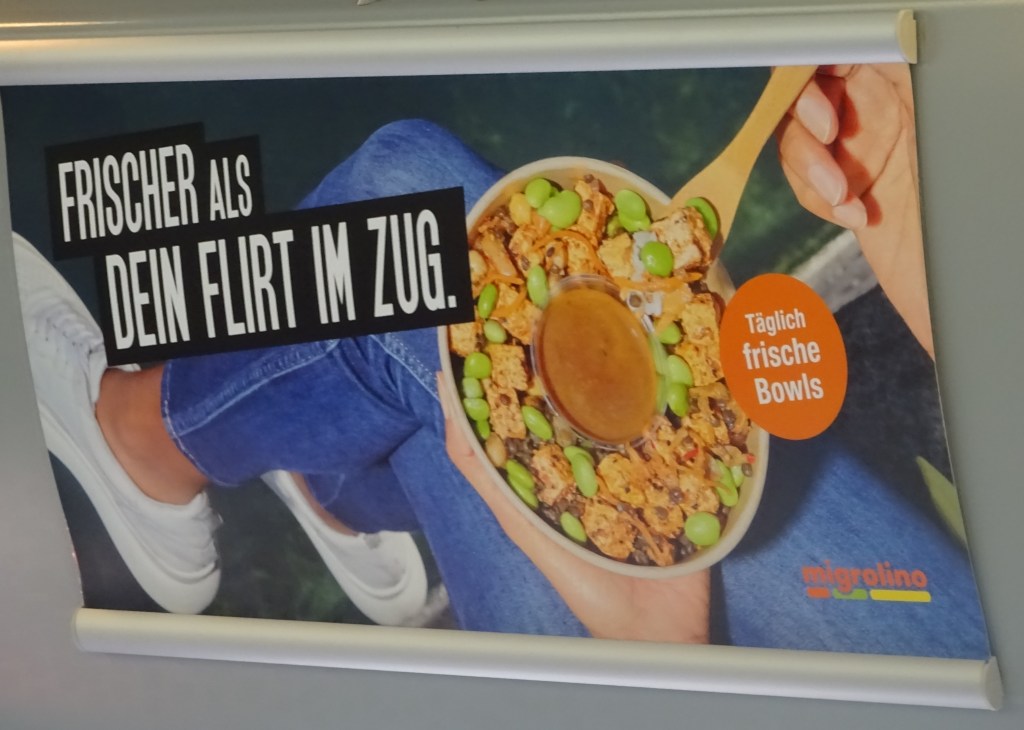
This train advert describes a supermarket salad in standard German as being “Fresher than flirting in the train” with “Fresh bowls every day”.

Finally, Basel residents and visitors are encouraged to take a relaxing river swim with a pun based on Rhy, the Swiss German word for the Rhine. Specific swimming times when a lifeguard is on duty make this a fun activity for all ages.

Food and drink

Swiss cuisine is also a treat. Start your day with Birchermüesli, now simply called muesli in the UK, and a choice of wonderful cheeses from Emmental and Gruyère to Vacherin and Appenzeller. Don’t forget your giplfeli (croissant(s)) and a kafi (coffee or Kaffee in standard German). Rösti (fried grated potatoes) also used to appear at breakfast, but are now more common with lunch or dinner. Basler Läckerli (lecker meaning ‘delicious’ in standard German and ‘-li’ indicating a diminutive) is a traditional hard, spiced biscuit made of honey, hazelnuts, almonds, candied peel and Kirsch (cherry liqueur).

Sightseeing

Each hotel guest currently receives a BaselCard making wi-fi and local public transport (trams, buses and regional trains) free with Basel’s many museums half price. The vast Kunstmuseum (art museum) is both eclectic and striking. Tracing the region’s Roman roots in Augusta Raurica and admiring Jean Tinguely’s kinetic fountains are other highlights along with wandering the cobbled streets of Basel’s old town. So, I was sad to say “Uf Widerluege” (“Auf Wiedersehen” or “Until we see each other again”) as the week came to an end.

Celebrating Translation and Interpreting at the ITI Conference

Embracing change, emerging stronger: this year’s ITI (https://www.iti.org.uk/) Conference theme lived up to its billing. With over 400 participants from around the world, the options were to attend in Brighton or online and even both, three quarters choosing to attend in person. The Hubilo app enabled delegates to join virtual lounges, contact others online and view the programme on the move or from the comfort of their PC at home. Sustainability was key with attendees encouraged to bring their own water bottles, paperless maps and programmes along with returnable lanyards. Most presenters were on site in the auspicious Grand Hotel on the seafront, but some also presented remotely.

A colourful sign at Brighton Station

Welcome drinks, networking meet-ups and the Gala Dinner created a celebratory atmosphere for those of us attending in person. The seaside venue also provided a holiday spirit as did the pleasant sunshine. Fringe events included guided walking tours, running, yoga and singing. I wondered whether online delegates could sense they were missing out. Perhaps, the online option was a bonus for those living remotely or with a busy half-term week.

Held from 30th May – 1st June, presentations ranged from practical business tips to learning a new specialism or language and the nitty-gritty of translation itself. Award-winning writer, editor and translator Daniel Hahn shared highlights of his recent real-time blog. Translation normally being an invisible task, in “Extreme visibility – on sharing a translation process” Daniel revealed his iterative method, spending months transforming a contemporary Chilean novel into English. He described some drafts as looking like “explosions in a multilingual nonsense factory” and sounding “like a badly tuned radio” before issues were ultimately resolved.

Brighton’s West Pier

Lloyd Bingham emphasised the need to switch from offering training in soft skills to mentoring new translators in core translation skills, as so little in-house experience is now available to provide them with vital feedback. We also need to reach out to translators beyond professional associations. Dot Roberts and Kelsey Frick showed us how to have fun disrupting LinkedIn. Starting her freelance translation career alongside the pandemic, Dot launched her “Meet the Translator” podcast – an alternative source of CPD and networking in remote times. Subtitling specialist Kelsey uses TikTok to showcase snapshots of her working life in a humorous way. Oliver Lawrence recommended translators consider the sound and rhythm of their text to create melodious and, consequently, attractive copy. Naomi Porter demonstrated how song translation can offer gains, shifts and creative choice resulting in a song worthy of performance.

Brighton’s Palace Pier

In these changing and hybrid times, embracing, and also making, changes will bring new positivity to our profession. We can emerge stronger by adapting, showing joy in our work and being cheerleaders for our colleagues.

International Translation Day 2021 – What Does a Translator Do?

International Translation Day falls on 30th September each year, the feast day of the famous translator St. Jerome. To celebrate, I thought I should reflect on the work of translators – those of us who turn documents from one language into another.

From contracts to birth certificates, academic reports and press releases, translators help so many individuals and businesses. During the many lockdowns, besides locally-produced TV films and dramas, “foreign” entertainment often featured with subtitles provided by translators. How would we discover new stories and comedy in books without the aid of translation?!

As travel eased, we have found airport guidance and sightseeing recommendations appear in our own language as if by magic. Have you bought a property overseas? A translator would most likely have helped with your conveyancing documents. Inventions and innovations, such as vaccines and medical treatments, have become widespread thanks to translation.

[St. Jerome in his study, picture courtesy of Wikimedia Commons]

Those translators who also work as interpreters (translating spoken language) have enabled online conferences and business meetings to take place, just as they helped in-person events in the past. Some interpreters also work in far more dangerous situations helping military forces overseas. Interpreters provide a vital service in medical situations and court proceedings for health and justice respectively by speaking the words of those unfamiliar with the language required. Translating and interpreting can smooth the path to getting the correct compensation you deserve after an accident or theft.

Without translation, we would miss out on so many opportunities and discoveries. If you want to find out more, check out the websites of the Institute of Translation and Interpreting (https://www.iti.org.uk/resource/celebrating-international-translation-day-2021.html) and the Chartered Institute of Linguists (https://www.ciol.org.uk/).

Translation comes at a Price or How my Love of Languages turned into the Art of Calculation (with apologies to Dr Strangelove)

When I started translating professionally, translation agencies offered me their rates. A common request is per 1,000 target words (the resulting translation), but a source word count is sometimes used. So, you need to be aware of the likely difference between source and target word counts. This depends on the type of document. There are certainly differences between languages as well. For example, compound German words become longer phrases in English. Will cultural/historical references require an explanation in the target language? Can a long instruction in the source language be turned into a snappy expression in the target one?

Minimum versus maximum

Of course, if a document is quite short, such as one page (300 words or fewer), you could offer a minimum fee. This is a flat rate. Whatever you charge, you need to know how long it takes to carry out each project in advance. In this way, you will meet your deadline and charge a fair price. Other rates used are per word, per question (for a quiz machine, for example) and per certificate. Here, you need to consider the time it takes to reproduce formatting.

It is also common practice to charge an hourly rate for revision, i.e. checking a translation against its source text and correcting it for translation errors along with grammar and spelling mistakes. A pace of 1,000 source words per hour is expected. If proofreading a text without reference to its source document, then 2,000 words per hour is reasonable. An hourly rate is also appropriate when there are some sections for translation and revision alongside others where only proofreading is required.

Different (key) strokes for different folks

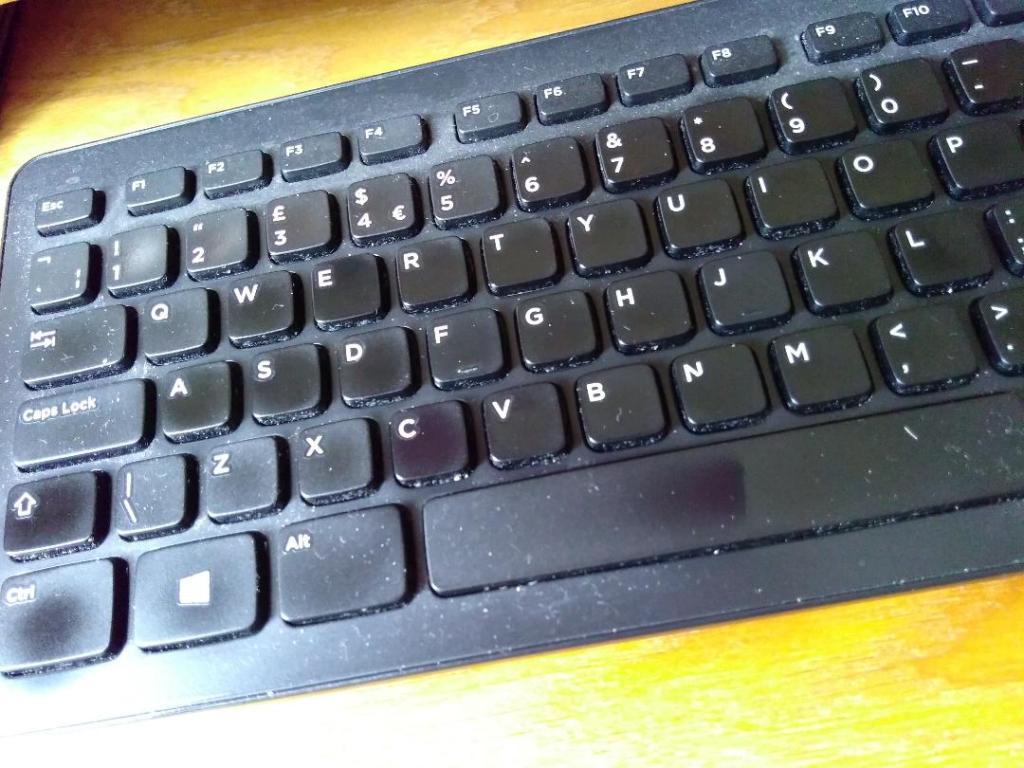
A price per line may also be quoted for a translation. A line is not a number of words, but 55 characters with or without spaces, based on the source or target text(!)

Having a variety of clients over more than two decades means that I have been paid in Australian dollars, German marks, Austrian schillings, Swiss francs, euro and pound sterling, to name a few. Currency converter websites are, therefore, a helpful guide to establishing a rate for your quote. This will not necessarily mean that you receive the same rate once you are paid though, unless you insist on payment in advance – exchange rates fluctuate and there may be bank charges. So, it is a mathematical jungle out there.

“Simplify, simplify” – Henry David Thoreau

In recent years, I have found several of my clients are happy with an hourly rate for proofreading, revision and translation. This works well. Be clear regarding the time required so that you can agree on a fair price. It takes time and experience to know what you can achieve in any timescale. Besides this, you also need unpaid time for admin, CPD, networking and holidays – remember to take a break!

With best wishes, in these difficult times, to all my clients and colleagues.

Friend or Foe? – German Coronavirus Terms to Confuse or Bemuse You

The German language enjoys borrowing English words. For example, ‘Manager’ and ‘Job’ are often used instead of ‘Leiter’ and ‘Arbeitsstelle’. Other English-sounding words, such as ‘Handy’, also exist; this means ‘mobile phone’, even though no English-speaking person would use this to describe their phone – a false friend indeed.

The COVID-19 crisis has created a vast array of terms in the UK and the German-speaking world. The Leibniz Institute for the German Language has compiled a list of vocabulary, available at: https://www.owid.de/docs/neo/listen/corona.jsp#. This includes a number of English-sounding words. Just as with the virus, we need to approach some of these with caution though.

When it comes to living under strict restrictions, where England has Tier 1, Germany calls this ‘Lockdown light’. A ‘Megalockdown’ is the opposite of this with the most extreme restrictions, such as ‘Tier 4’. Restrictions might arise not only from governmental legislation, but also be forced on you by prolonged snowfall with the rather delightful ‘Flockdown’.

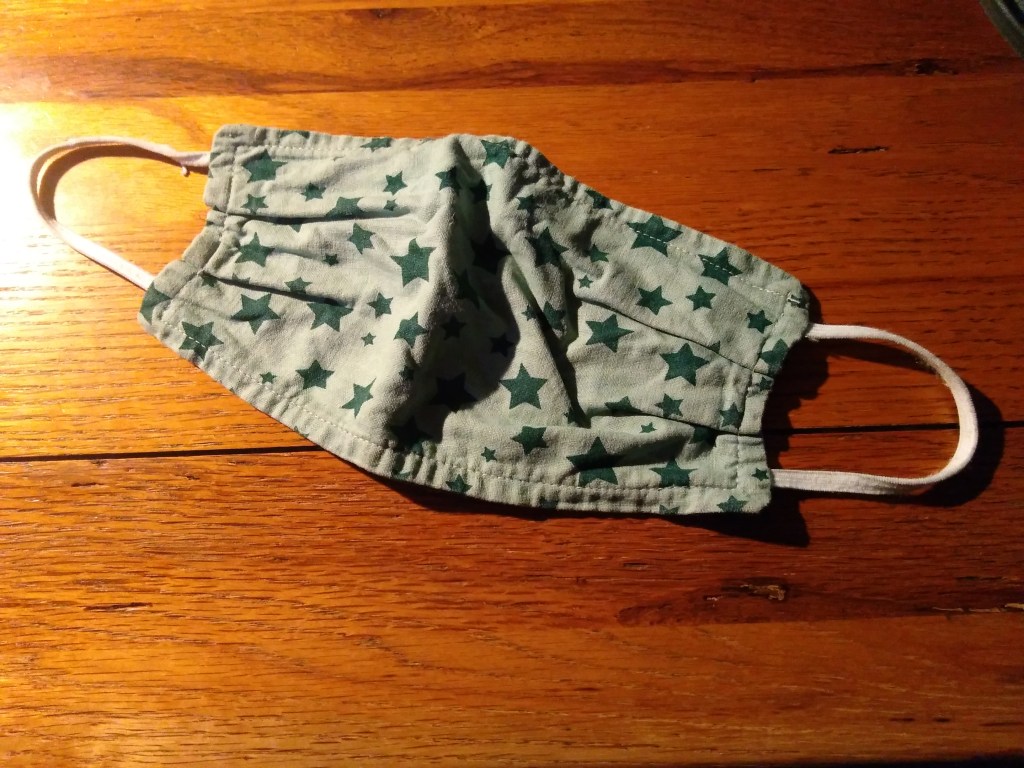
For appearance, Germany insists on a ‘Mask-have’ (a mandatory face mask) with this being ‘Coronafashion’. If you have to manage your own hairstyle, this is referred to as a ‘Coronacut’.

(One of my own masks, above)

While ‘Zuhause’ means ‘at home’, domestic work and entertainment have happily adopted ‘home’. So, ‘Homeclubbing’ means ‘dancing at home to music via the Internet on a video call with friends’. Why not? Confusion might start though when asking about how things are going in the ‘Homeoffice’ – not a UK governmental department, but the official German term for homeworking.

If you can leave your home, you might like to cycle on a ‘Pop-up-Bikelane’ (the term ‘Pop-up-Radweg’ is also available). When the option of long-distance travel is no longer possible, you might like a ‘Holistay’, more commonly known in English as a ‘staycation’.

A recent term, which might be added to the official list soon, is ‘Impfluencer’. With ‘impfen’ meaning ‘to vaccinate’, an ‘Impfluencer’ is someone who can influence others to get a COVID-19 vaccine. While we wait to be vaccinated or have to shield, both German and English speakers will have to continue ‘Social Distancing’, but can also indulge in a few ‘Quarantini’.