Social Media Mayhem or Effective Marketing?

Having recently helped promote a workshop on Facebook and LinkedIn, it was interesting to have some feedback on our main topic of marketing. Although not universally popular, it is necessary if you want potential and existing clients to know what you do and whether what you offer has changed.
[Photo by Merakist on Unsplash]

How can clients find you?

So, what is marketing? According to Oxford Dictionaries, marketing is “the activity or business of promoting and selling products or services, including market research and advertising”. CIM, the Chartered Institute of Marketing, defines marketing as “the management process responsible for identifying, anticipating and satisfying customer requirements profitably. This may sound somewhat cold and calculated, but, unless you are translating as a hobby, you presumably need a strategy to make this your career.

Do you know your market?

If you have professional experience or qualifications in a specific subject, besides languages, this could be your main source of work. Do you know the clients who would benefit from translation in this field? Where are they based? Could you work for them directly? If you don’t have any specialist experience, do you have any hobbies or interests that you could develop into a specialism? Do you work for agencies? If so, are you happy with the projects on offer and the rates paid? How can you change this, if you’re not happy?

Do you have a website? If not, how do you communicate to potential clients about what you do? Can they find you on a professional database, such as that of the ITI (Institute of Translation and Interpreting) (https://www.iti.org.uk/find-professional-translator-interpreter.html) or CIOL (Chartered Institute of Linguists) (https://www.ciol.org.uk/find-a-linguist)? Do you have a blog? Do you use social media? Do you network with colleagues? Do you attend trade shows and conferences?

[Photo by Mariia Shalabaieva on Unsplash]

So many questions, so little time

If this all seems overwhelming, take some time to reflect on whether you are happy in your work. If something could be better, do something to change that. There are so many opportunities to improve your situation. You may also find you enjoy particular projects and want to increase your work in that area. If so, tell your client how much you enjoy what they do and how you like being part of their team.

Meanwhile, if you want more expert advice, ITI’s Western Regional Group (https://www.itiwrg.org.uk/news.php) will be holding its Members’ Day on Saturday 15th November. Here, Sara Witham of Evil Empire Marketing (https://evilempire.co.uk/) will offer you some answers on how to market yourself. If you have any ideas and wish to share them, please drop me a line in the comments.


From Planting to Flourishing

For weeks, I have been watching spring bulbs in our garden growing green shoots. Each day, there would be more, but no flowers. Then, a week ago, the first flower appeared and more kept popping up and opening as if by magic.

[An allium in bud and a flowering allium]

Just yesterday, I attended a Zoom networking event. One of the topics discussed was how to find clients – relevant to any freelancer of course. You might have qualifications and be ready to work, but where is anyone who needs you? What on earth have these 2 scenes got in common?!

Well, after applying to translation agencies whilst studying on my MA, several polite replies came, some happy to ‘keep my name on file’, but no actual work offers arrived. I did some temping and evening classes in subjects related to my interests and potential work. One day, just over a year later, an agency that had ‘kept my name on file’ contacted me with a genuine project. After successfully completing it, I realised I was now a practising translator, not just a qualified one. This agency gave me more work. I could write about the work I was doing on my CV. Other agencies offered me work, then colleagues did so and referrals from colleagues even opened up opportunities to work with direct clients. These then recommended me to other direct clients. Somehow, the seed I had planted was starting to flower. Was I simply lucky? This is partly true. I am also extremely grateful for the advice I have received.

How to blossom as a translator:

1) Be (politely) persistent!

2) Join a professional organisation whilst studying. You can learn new skills in workshops and meet colleagues. Both the Chartered Institute of Linguists https://www.ciol.org.uk/ and the Institute of Translation and Interpreting https://www.iti.org.uk/, with its many subject, language, regional and support networks, offer solidarity and an opportunity to advertise your skills.

3) Learn from experienced translators at workshops and in forums – everything from subject and language skills to setting up your office and online presence.

4) Be flexible – not all work is translation or interpreting. Proofreading and editing are often required.

5) Be sociable – networking is not just about work, but should be fun. There are regular meet-ups with colleagues from pubs to walks and art exhibitions.

6) Write about what you do workwise and in your spare time – on your website, in professional journals and anywhere relevant to your specialisms. One of my hobbies has become a specialist subject in my translation work.

7) Be optimistic!

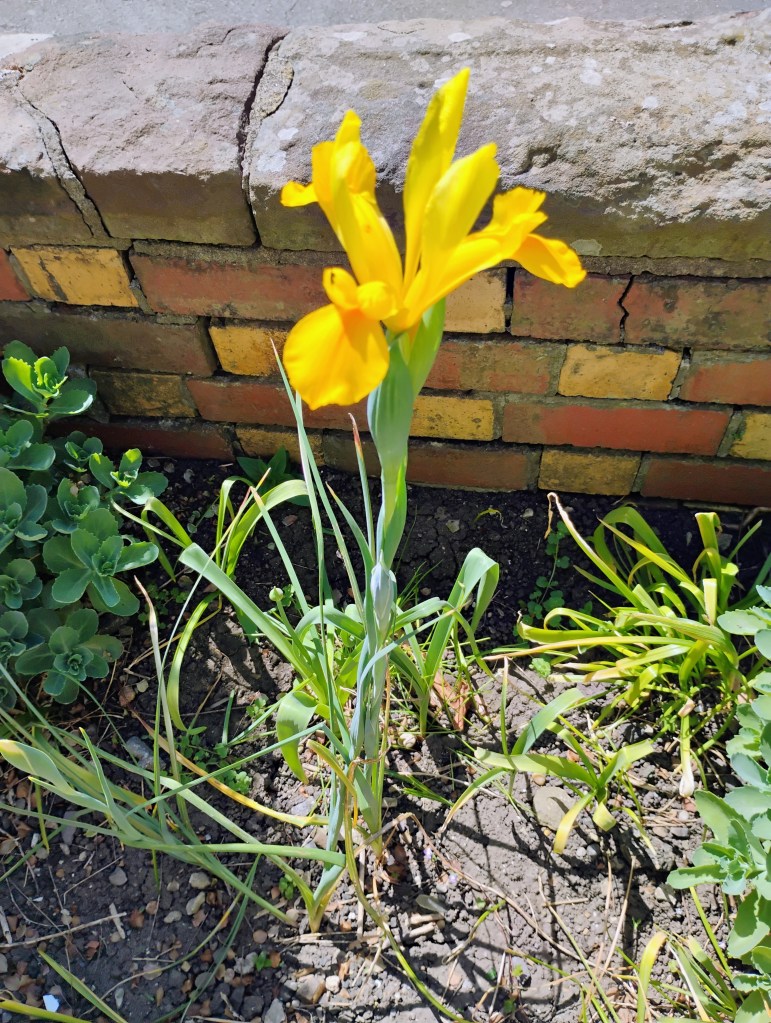
[A yellow iris]

Good luck!

Ode to Autumn Networking

John Keats described autumn as the “season of mists and mellow fruitfulness”. So, it feels like a time to wind down before the year ends. It is also, in contrast, the start of the new academic year and, therefore, a time to refresh our perspective. For me, there have been several networking events from a Business Boost Day to the Members’ Day for my regional network through to ‘Netwalking’ (walking and networking in the Forest of Dean) alongside online events in my subject and language networks.

[Fallen leaves near the Dean Heritage Centre, Gloucestershire]

Becoming fruitful

As freelance translators, it’s easy to keep working without reflecting on our business strategy. Momentary disappointments may seem huge without taking time to assess our successes. At a Business Boost Day in September, we were encouraged to assess what has changed in the past 18 months in terms of our workload, client base, specialisms and earnings. Then, we discussed how we can react and adapt to change. We also talked about our success stories with an action plan to focus on work from our favourite clients.

Being mindful

A session on mindfulness at our Members’ Day made a room full of linguists fall silent – more than once! Focusing on our breath, however, brought clarity of thought and new insights into how we could improve our working day to stop us feeling overwhelmed. Even walking can be mindful if you take each step slowly and keep your mind free by again focusing on your breathing.

Netwalking

Spending what turned out to be a splendid autumn day walking in the Forest of Dean, Gloucestershire, was a great escape from our desks. It was a chance to discuss work, network and walk – hence the term ‘netwalking’. Appreciating our surroundings, our colleagues and considering our work/life balance was uplifting. Our reward for a good 2 hours of walking was delicious refreshments in the Dean Heritage Centre Café.

[The Forest of Dean, Soudley, Gloucestershire]

The year ahead…

Bringing together these positive experiences gives me renewed energy. I look forward to working with focus and creativity for my clients and with my colleagues.

———————————————————————

With thanks to Becca George (ITI Western Regional Group) and Lloyd Bingham (ITI Cymru Wales Group) for the Business Boost Day, Claire Moreau of Bridgemaker Mindfulness for the mindfulness session as part of the ITI Western Regional Group’s Members’ Day and Astrid Freuler (ITI Western Regional Group) for the guided ‘Netwalking’. More details about the ITI (Institute of Translation and Interpreting) are available here:

https://www.iti.org.uk/

AI Chatter – Do Shortcuts Matter?

A job advert recently popped into my inbox. It was in English, but the job itself was based in Germany. A line in the email simply recommended using “intelligent programs” to understand the job description on the company’s website.

How odd, I thought. If you want to work abroad, it certainly helps if you can read and write the relevant language – from shopping to getting a doctor’s appointment through to enjoying hobbies and making friends. Having worked in Germany, this seems obvious to me. So, why would you expect someone to use a tool to understand their future working environment?

Save time and get the gist

What is an intelligent program? The OED defines AI (artificial intelligence) as “The capacity of computers or other machines to exhibit or simulate intelligent behaviour […].” A popular AI tool, ChatGPT, is just one example. It is a large language model (LLM) that can save you time and help you get the gist of what you’re reading. LLMs are trained on large amounts of data to enable them to “understand” and generate a natural language style. Chat GPT could write a Victorian novel for you or give you advice on just about anything, apparently.

But is the gist enough?

AI models are often very complementary about their own achievements. According to a 2023 Forbes headline, “AI Could Help Find Life On Mars With 90% Accuracy, Scientists Say”[1]. When it comes to translation, 90% accuracy sounds great until you realise that means 1 in 10 words is wrong.

For example, one tool translated ‘untermauern’ (German for ‘to reinforce’ or ‘substantiate’) as ‘undermine’ – the complete opposite of what it really means. The tool understood ‘unter’ correctly as ‘under’ and then failed to work out the rest. What happens when there are not just 10 words, but 10 pages or even 100 pages?

As AI can only reproduce text based on previous documents, it cannot create something new. This is why it stumbled when faced with an unfamiliar word. There is also a copyright infringement risk if you use it to translate confidential documents. Added to this is the high processing power of these tools – an adverse environmental impact. Excessive demand from users can also cause outages that completely stop a system from working.


[1] https://www.forbes.com/sites/jamiecartereurope/2023/09/25/new-ai-could-help-find-life-on-mars-with-90-accuracy-say-scientists/?sh=6cf72f8b4c40

Bridging the gap?

AI tools appear to read, but what are they really doing? They are analysing text based on existing data using algorithms. They piece this data together into phrases as a translator would. But they can only do so based on old information. They do not actually understand what they are reading or writing.

What makes my job exciting is that language is dynamic and beyond the scope of machines. I make new discoveries all the time. As the world changes, new words emerge. Some become more popular, while others disappear. Some change their meaning too – don’t get caught out!

You wouldn’t look at an old map to find a safe route across a river. So, why trust a tool that is searching for old information to tell you something new? AI can only take you so far. Without translators and interpreters, you would be lost!

[Images courtesy of Wikimedia Commons]

With thanks to my colleagues in the German Network of the Institute of Translation and Interpreting (https://itigermannetwork.org.uk/) for a recent online discussion, which inspired this article.